
Be ready for
anything.
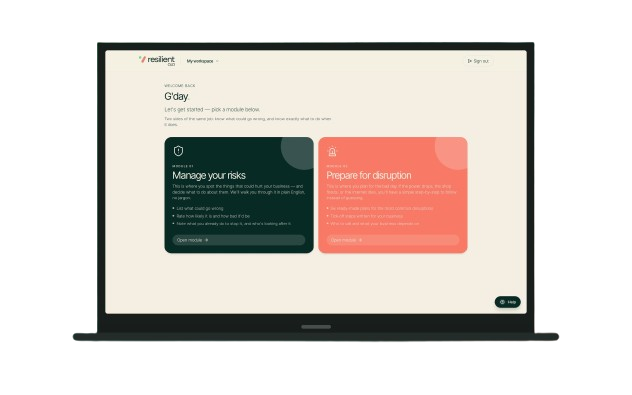
An app for Queensland businesses. One half lists what could shut you down, floods, cyclones, blackouts, cyber attacks, losing key staff. The other half tells your team exactly what to do when it happens, step by step, on their phone.
How it works
Set it up once, then two modules do the work.
Stage one
Set it up once.
Tap any step for detail
Stage two
Then each module does its own job.
Why this exists
Most small businesses have no plan.
Not because they don't care. The tools built for this were made for big companies with a risk team, a consulting budget and a year to spare. Small businesses have none of that.
ResilientQLD was built from the other direction: from the operator standing in a cafe at 6am with no power, no EFTPOS and a delivery arriving in twenty minutes.
It's designed by a practitioner with a background in serious organised crime investigation, Fortune 100 business resilience and crisis leadership, and corporate cyber resilience — translated into something a business owner can actually run on their own.
Small and medium operators
Cafes, retail, hospitality, trades, clinics, professional services and community organisations.
The people who act
Owners, venue managers, duty managers and the staff member who happens to be on shift when it goes wrong.
The people who ask
Insurers, funders, franchisors, councils and clients who want evidence of a real plan.
What you're up against
Six pressures, all at once.
Queensland's next decade brings growth: the 2032 Games, major infrastructure, and steady interstate migration. It also brings pressure, and these six compound each other.
When one of them lands, most small businesses improvise. That is the problem this app was built to fix.
Severe weather
Floods, cyclones and storms are more frequent and more costly. Premises, power and access tend to go at the same time.
Cyber attacks
Small businesses are now a primary target. Email compromise, ransomware and outages land on firms with no IT team behind them.
Third-party reliance
Your POS, bank, telco, cloud and suppliers are all single points of failure you do not control.
Major events pressure
Brisbane 2032, major infrastructure and event-driven tourism will congest roads, drain staff and disrupt normal trade for years.
Supply chain fragility
Just-in-time delivery, single suppliers and long freight lines mean one road closure or delayed shipment can stop you trading.
Workforce pressure
Key people, casual staff and seasonal workers are hard to replace. One resignation, illness or roster collapse can stop the business.
Module one
Know what could go wrong.
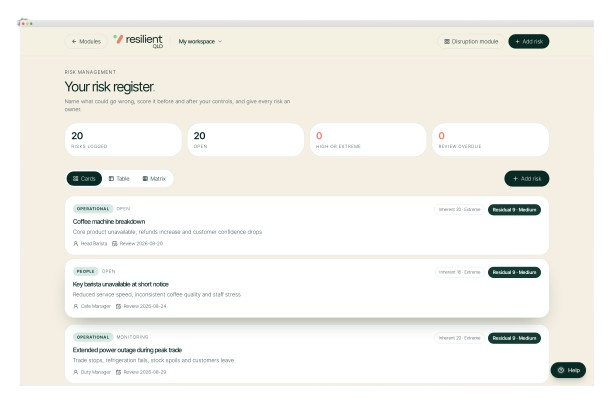
A proper risk register, in plain English. What could go wrong, how bad it would be, what you already do about it, and who's responsible.
Three ways to read the same register
Different questions need different views.
Cards
Scan-friendly view for reviewing risks one by one, with score, owner and status on the face of each card.
Table
Dense, sortable view of the full register for workshops, board packs, insurers and audits.
Heat matrix
A 5x5 grid plotting likelihood against impact. The top-right corner tells you where to start.
Plus category taxonomy, status tracking and register-wide statistics. No exports, no spreadsheets.
Module two
Know exactly what to do.
You can't predict every event, but you can plan for the six things you can lose. Flood, fire, a cut cable or a digger through the line all end the same way — and need the same response.
Loss of Power
Outage, grid fault, storm season, generator failure.
Loss of Premises
Fire, flood, structural damage, police cordon, landlord access.
Loss of Personnel
Illness, injury, resignation, key person gone, roster collapse.
Loss of Internet
Carrier outage, hardware failure, no EFTPOS, no bookings, no cloud.
Loss of Communications
Phones down, email compromised, unable to reach staff or suppliers.
Hostile Environment
Aggression, threat, protest, cyber attack, extortion, unsafe site.
Shared foundation
Lightweight by design. Powerful where it counts.
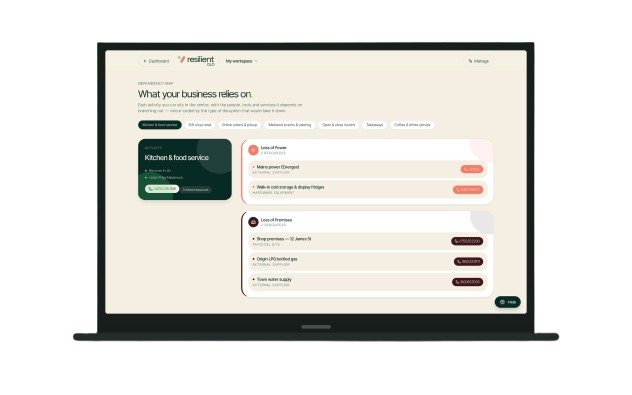
Both modules draw on the same underlying picture of the business, so work done in one place strengthens the other. Add a supplier once and it appears in your dependencies, your playbooks and your risk owners.
Export the whole plan to PDF in one click, so you always have a printed backup when the network — or the device — lets you down.
On the day
Frictionless from day one.
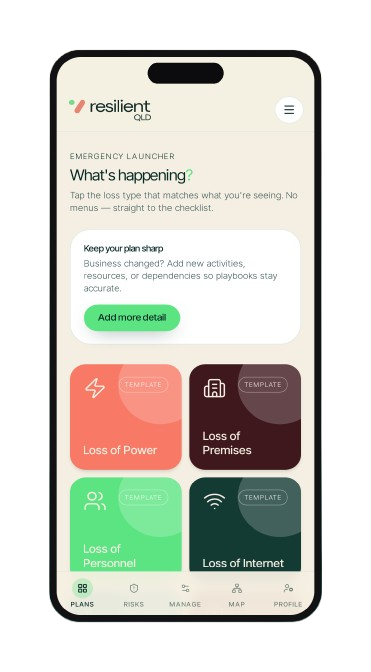
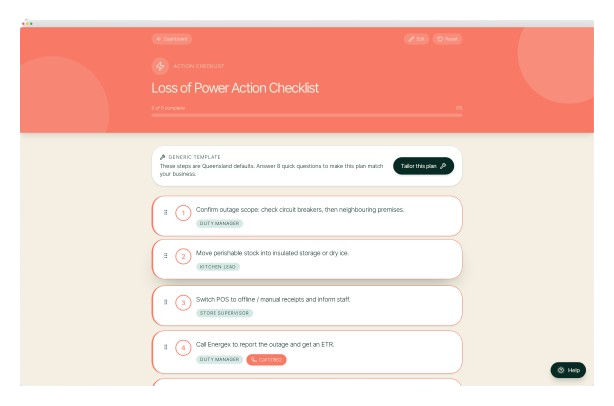
No training required. The staff member on shift opens the app, presses the button matching what's been lost, and starts working through concrete actions immediately.
Checklist progress is preserved, so an incident can be handed between people without losing state. The numbers you need are already in the plan and already tappable.
Small businesses don't fail because they lacked a framework. They fail because on the worst morning of the year, nobody knew what to do first.
Ease of use
Set up in an afternoon.
Ten questions to a working plan
Onboarding is ten plain-English questions, not a discovery workshop. From those answers the system provisions your activities, resources and six draft playbooks. Nobody starts at a blank page.
Genuinely mobile
Built mobile-first, not shrunk down from a desktop layout. A fixed bottom tab bar gives one-thumb access to modules, plans, risks and settings. High contrast, large targets, no fine print.
Queensland context
Energex, Ergon, Telstra, Optus, BOM, QPS, SES and your local council — pre-wired. Cyclone, flood and bushfire framing baked into the language.
Help where you need it
Recovery time objective, residual risk, single point of failure — all explained inline at the moment you need them. A revenue impact calculator turns a vague worry into a defensible number.
Works offline
Local caching means the plan is on your phone even when the tower's congested or the internet is the thing that's gone down.
Export and print your plan
One-click PDF export gives you a hard copy for audits, site folders, or the days when the battery dies.
On the phone in your pocket
Same plan, one-handed.
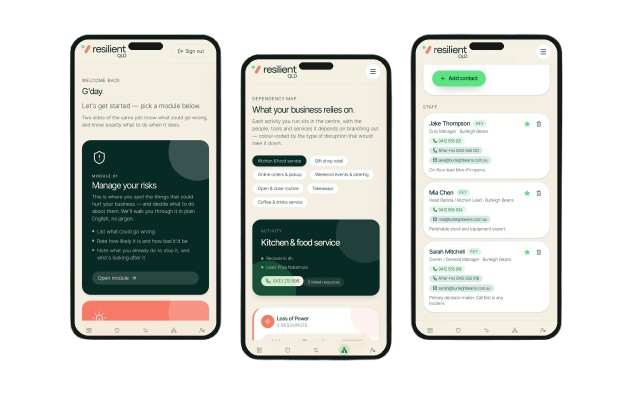
Module picker, dependency map and contacts all work on a phone, so the person on shift can run the plan without finding a laptop.
Built for your sector
Find your industry.
Each guide covers the disruptions that actually stop your sector trading in Queensland, the obligations you're held to, and how the app handles them.
What it costs
Only $1,299 first year, then $999 per year.
The app for twelve months, unlimited users, PDF export, and a one-day implementation where we set the whole thing up with you. No setup fee on top.
Implementation day
A full day with us. Risks scored, playbooks written, contacts loaded. You finish with a plan that works.
Everyone on the team
Unlimited users, on any phone. No per-seat pricing to think about.
Scenario test
Half a day running a real disruption against your plan, then fixing what breaks.
Crisis leadership training
Half a day training the people who will be making the calls on the day.
One plan you'll actually open when it matters.
Only $1,299 first year, then $999 per year, with the implementation day included.
Guides from the app.
Practical Queensland guides that use the same method the app is built on.